Human behaviour · 2022
Modelling how people find their way
Shortest-path models assume people know where to go. This work instead combines a vision-based cognitive agent with a navigation space extracted from building information models. A virtual-reality experiment with 149 participants provides a behavioural comparison. Cognitive agents show correspondence with human wayfinding patterns that direct-routing agents do not, supporting more realistic evaluation of architectural designs.
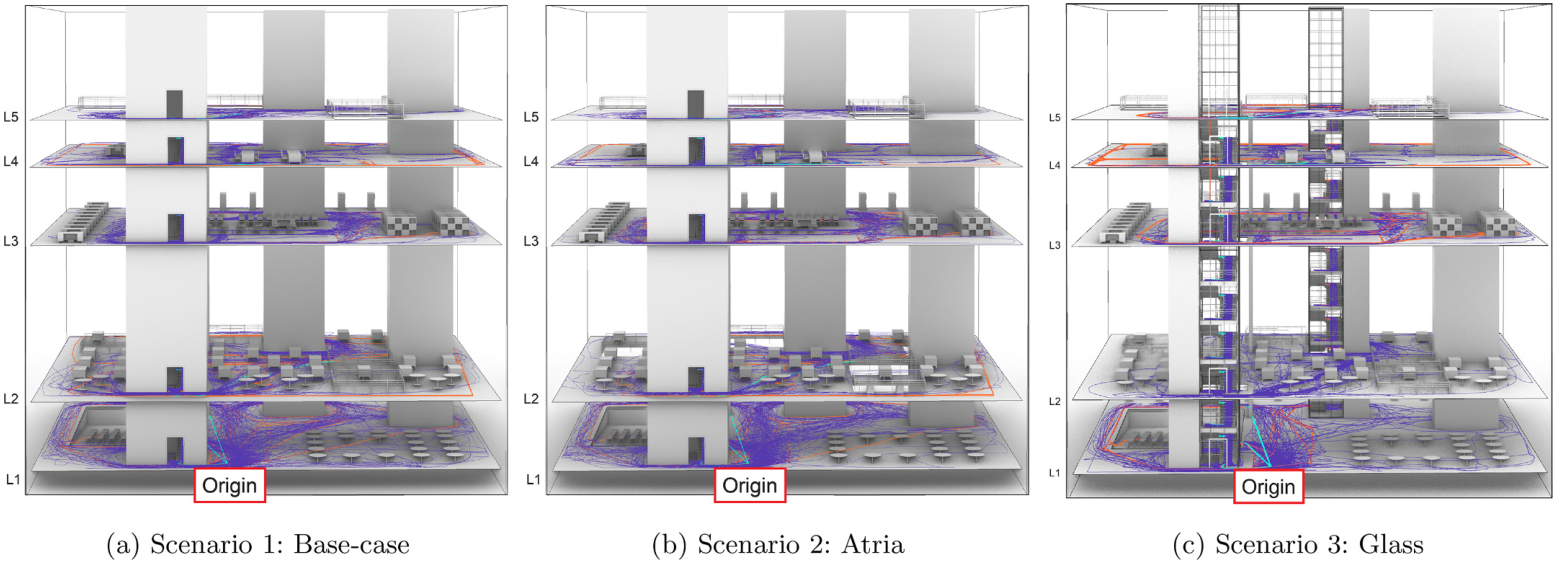
Human and simulated trajectories overlaid on three-dimensional building layouts.
Gath-Morad et al., Published article with ETH repository cover, Figure 6. Extracted from PDF page 10; page surroundings cropped; figure content unchanged. Source · CC BY 4.0.
Open full-size figureJournal article
Beyond the shortest-path: towards cognitive occupancy modeling in BIM
Michal Gath-Morad, Leonel Enrique Aguilar Melgar, Ruth Conroy-Dalton, Christoph Hölscher
Automation in Construction · 2022
Summary based on Published article with ETH repository cover, PDF pages 2, 10, 12.
DOI: 10.1016/j.autcon.2022.104131