Human behaviour · 2025
Bringing behavioural evidence into full-scale design
A 19-participant pilot compares screen-based presentations with full-scale healthcare mock-ups containing projected behavioural data. Participants use interaction hotspots and role-play to interpret spatial evidence. The immersive group achieves a higher median score, but the difference is not statistically significant. The framework demonstrates a way to bring behavioural evidence into collaborative design and motivates larger studies.
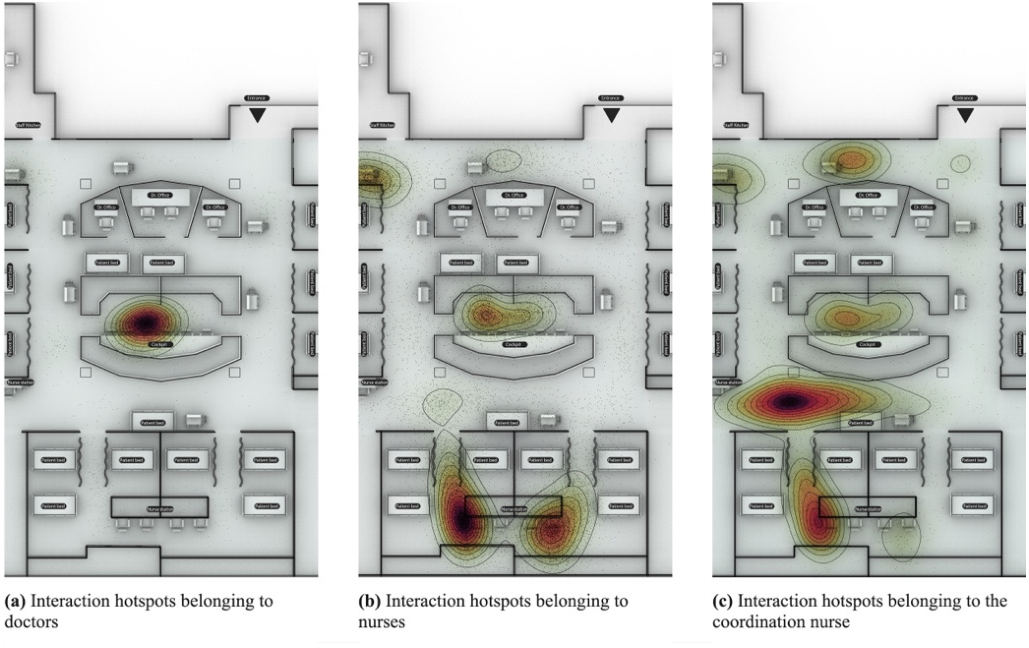
Interaction-hotspot maps for doctors, nurses and the coordination nurse, used in the emergency-department mock-up. Original Figure 2.
Gath-Morad et al., Conference manuscript in Cambridge repository; proceedings pages 407–416, Figure 2. Extracted from PDF page 6; page surroundings cropped; figure content unchanged. Source · CC BY 4.0.
Open full-size figureConference contribution
Immersed in Evidence: integrating behavioural data into full-scale healthcare prototypes for evidence-based co-design
Michal Gath-Morad, Leonel Aguilar, Raphaël Baur, Minou Afzali, Koen Steemers, Kerstin Sailer, Ruth Dalton, Christoph Hölscher
Proceedings of CAADRIA 2025 (30th Conference on Computer-Aided Architectural Design Research in Asia) · 2025
Summary based on Conference manuscript in Cambridge repository; proceedings pages 407–416, PDF pages 1, 6, 8, 9.
DOI: 10.52842/conf.caadria.2025.4.407